

The problem with traditional copier leases
Most copier leases run 36 to 60 months and are written to renew themselves. Somewhere in the fine print is a notice window, often 90 to 120 days before term end, and often the notice has to arrive by certified mail to count. Miss that window by a day and the lease can automatically renew for another full term, sometimes at the original rate for equipment that is years past its useful life.
Even without an auto-renewal trap, a fixed multi-year term locks you into a device and a payment regardless of what happens to your headcount, your print volume or your office. If the organization changes, the lease does not.
How LeaseFlex works
LeaseFlex starts with a 12-month minimum term. After that minimum, it converts to month-to-month automatically — no paperwork, no renewal notice required. From that point you can upgrade, downgrade or cancel at any time.
- Month-to-month after a 12-month minimum
- Free delivery, installation and pickup at 12+ months
- Upgrade, downgrade, or cancel any time
- No letters of intent
- No certified mail
- No auto-renewals
- No hoops to jump through
- $0 penalty to walk away — ever
Traditional lease vs LeaseFlex vs Purchase
| Factor | Traditional lease | LeaseFlex | Purchase |
|---|---|---|---|
| Minimum term | 36 to 60 months | 12 months | None — one-time purchase |
| After minimum term | Locked in until term end | Month-to-month | You own the equipment |
| Cancellation notice | Often a written notice window, sometimes by certified mail | No letters of intent, no certified mail | Not applicable |
| Auto-renewal risk | Common — missed windows can renew the term | None | Not applicable |
| Monthly cost for a 5-year hold | Typically the lowest | Typically higher than a 60-month lease | No monthly payment after purchase |
| Flexibility to upgrade or downgrade | Limited, usually only at term end | Any time after the 12-month minimum | Requires a new purchase |
| Upfront capital | None | None | Full purchase price |
LeaseFlex vs. traditional copier lease — at a glance
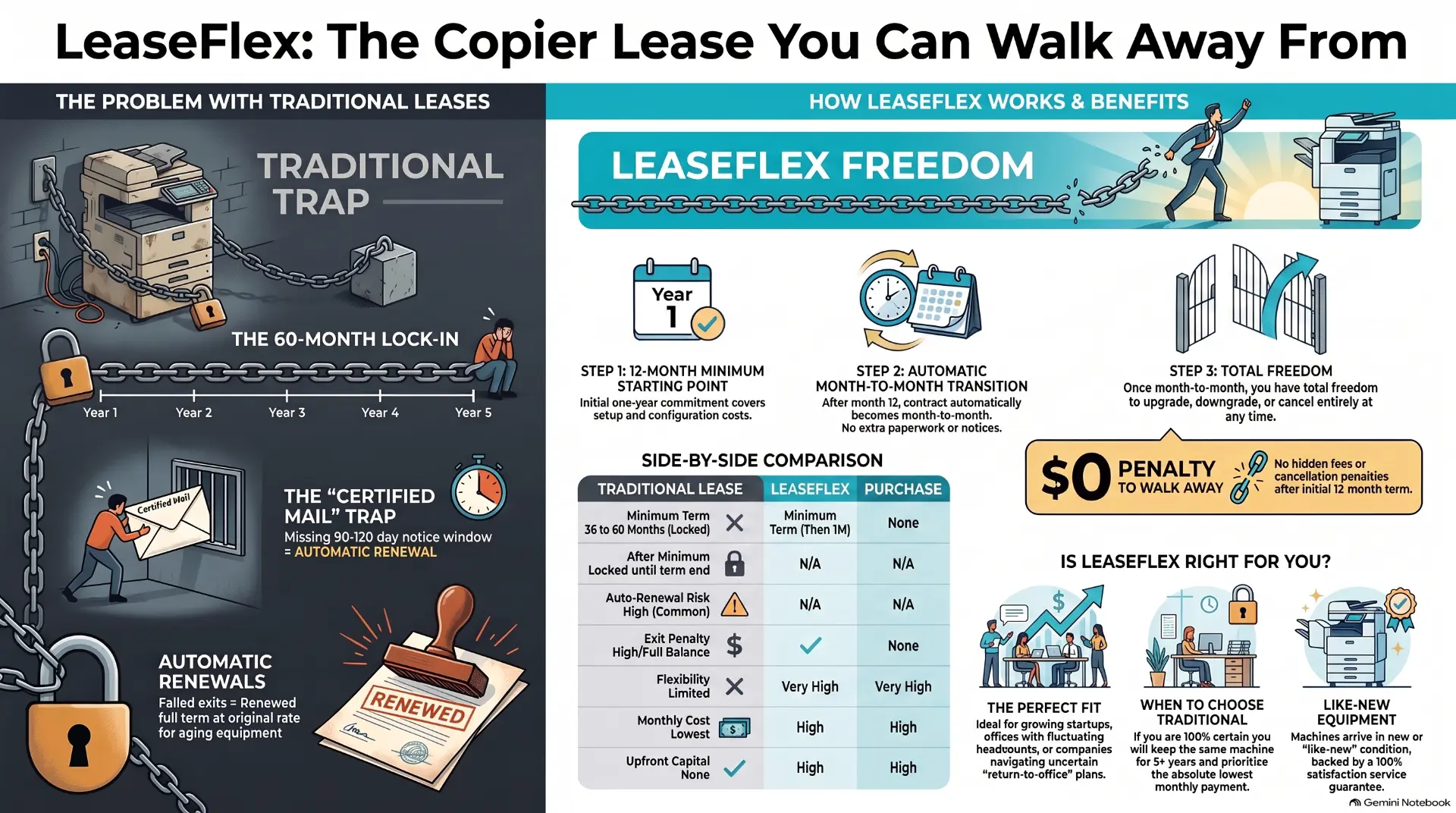
The diagram below summarizes the traditional lease trap, how LeaseFlex works, and the side-by-side comparison. Click the image to open a larger view.
Who LeaseFlex suits — and who it does not
Good fit
Growing or changing organizations, offices unsure of their volume or headcount a year from now, and anyone who has been caught by a certified-mail notice window or an auto-renewal clause on a previous lease.
Not the best fit
If you are certain you will keep the same device for a full five years and want the lowest possible monthly payment, a traditional 60-month lease will usually cost less per month than LeaseFlex. We will tell you that honestly when you get a quote.
Frequently asked questions
Is there a penalty to cancel LeaseFlex?
No. There is no cancellation penalty. Once you have completed the 12-month minimum, you can walk away for $0.
What if I need the machine for less than 12 months?
You can do that. When a machine stays with you 12 months or longer, we cover delivery, installation and pickup. Under 12 months we ask to be reimbursed for those costs, because they are real out-of-pocket expenses on our side — a truck, a crew, the setup and network configuration, and the pickup at the end. It is a reimbursement of hard costs, not a penalty, which is why we would rather you take the machine for a full 12 months and get all of it free.
What is the catch?
There is no catch. Some companies do not mind a longer lease — 3, 4 or 5 years — and in fact that has been the traditional setup for the past 30 years. However, some companies are experiencing too much change: they may grow, downsize, move, be on an M&A freeze and only able to make a short commitment, have people retiring, or simply prefer flexibility in an AI world where nobody knows what things will look like in 2, 3 or 5 years. LeaseFlex is built for them.
Are the machines new?
Great question. Our machines all come in new; however, the machine you get may arrive in like-new condition with a very low meter. It is like when you rent a car at Avis or Hertz — you will likely get a new model car with some low mileage. Our machines are all under the same service agreement and service level agreement, and if any machine is deemed not 100% it will be changed out immediately. Remember, with LeaseFlex it is our job to make sure you are 100% satisfied, because at any time you can call us to come pick up the machine.
Is LeaseFlex cheaper than a traditional lease?
Not necessarily. A traditional 60-month lease usually carries a lower monthly payment for an organization certain it will keep the same device for five years. LeaseFlex trades some of that discount for the ability to change or exit early without penalty.
What happens if I already missed a cancellation window on my current lease?
Our end-of-lease help page walks through what to do next, and moving to LeaseFlex avoids the same problem going forward.
Price out LeaseFlex for your office
We will quote LeaseFlex alongside a traditional lease and a purchase option so you can compare the real numbers before you decide.